
Label the Eukaryotic Cell: Interactive Diagram Quiz
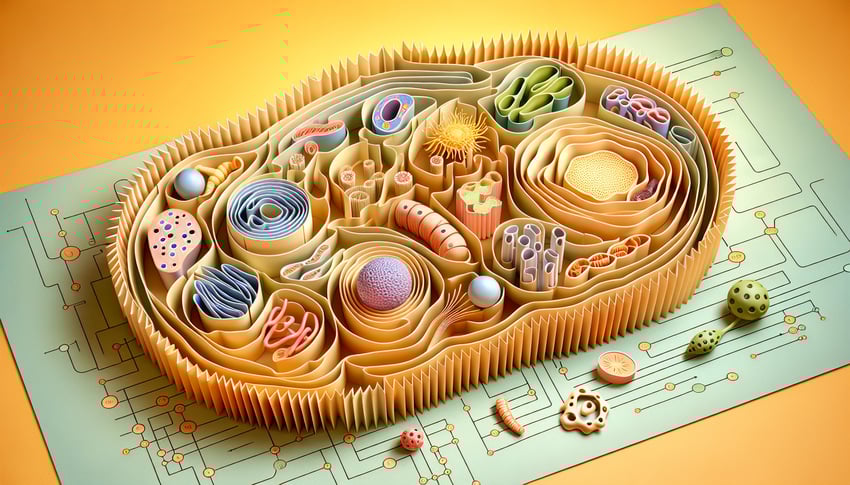
This quiz helps you label the eukaryotic cell and place each organelle in the right spot. Practice on a blank diagram, get instant feedback, and learn from mistakes before the test. Keep building skills with an animal cell labeling quiz, try a prokaryotic cell labeling quiz, or review parts in a cell organelles quiz.
Study Outcomes
- Identify Major Organelles -
Recognize and name the key organelles found in eukaryotic cells based on their structural characteristics and functions.
- Label Blank Diagrams -
Accurately place organelle names onto a blank eukaryotic cell diagram to reinforce spatial understanding.
- Differentiate Organelle Functions -
Distinguish each organelle by its unique role within the cell and understand how these functions interrelate.
- Apply the Answer Key -
Use the organelles in eukaryotic cells answer key to self-check responses and improve labeling accuracy.
- Assess Your Knowledge -
Evaluate your mastery of cell anatomy through an interactive eukaryotic cell labeling quiz.
- Analyze Structure-Function -
Examine how the form of each organelle relates to its function and overall cell health.
Cheat Sheet
- Nucleus & Genetic Control -
Often called the "command center," the nucleus houses DNA and directs cell activities via mRNA transcription. Remember the mnemonic N.E.P. (Nucleolus, Envelope, Pores) to quickly spot key features when using a blank eukaryotic cell diagram. When completing your eukaryotic cell labeling quiz, check against the organelles in eukaryotic cells answer key to confirm you've marked the nuclear pore complexes correctly.
- Endomembrane System Coordination -
The rough ER, smooth ER, and Golgi apparatus work in sequence to synthesize, modify, and package proteins and lipids. Think "R-G-S" (Ride-Gang-Ship) as a fun way to trace a protein's path: RER→Golgi→secretory vesicle. Practice this pathway on your blank eukaryotic cell diagram and then cross-reference with the eukaryotic cells worksheet answer key for spot-on labeling.
- Energy Powerhouses -
Mitochondria convert glucose into ATP via cellular respiration (C6H12O6 + 6O2→6CO2 + 6H2O + ~36 ATP), while chloroplasts enable photosynthesis (6CO2 + 6H2O→C6H12O6 + 6O2). Use the catchy phrase "Power Houses Make ATP" to remember mitochondrial cristae and matrix regions. After labeling in the eukaryotic cell labeling quiz, review the organelles in eukaryotic cells answer key to confirm cristae details.
- Cytoskeleton & Intracellular Transport -
Microtubules, microfilaments, and intermediate filaments form a dynamic framework that supports cell shape and directs vesicle movement. Visualize microtubules as "highway lanes" for motor proteins and use the phrase "M.T. moves traffic" to lock it in memory. Check your work on the blank eukaryotic cell diagram against the eukaryotic cells worksheet answer key to ensure you've correctly placed actin filaments and tubulin strands.
- Vacuoles, Lysosomes & Maintenance -
Vacuoles store nutrients and waste in plant and fungal cells, while lysosomes use hydrolytic enzymes to recycle cellular debris. Remember "Vacuums swoop, Lysosomes loop" for an imaginative cue that vacuoles expand and lysosomes degrade. Verify your labeling on the eukaryotic cell labeling quiz and consult the organelles in eukaryotic cells answer key to ensure digestive vesicles are accurately marked.