
Organelle Function Quiz: Test Cell Parts and Their Jobs
This organelle function quiz helps you match each cell part to its job and check your understanding with instant feedback. For more practice, try the cell organelles quiz, build identification skills with an organelle labeling quiz, or focus on plants in a plant cell labeling quiz.
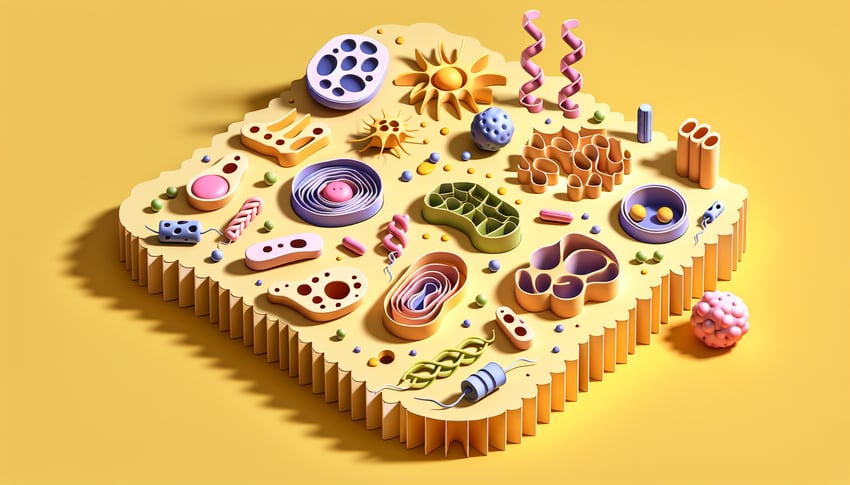
Study Outcomes
- Identify Key Organelles -
Learn to recognize and name major cell organelles - mitochondria, ribosomes, Golgi apparatus, lysosomes - when encountering them in diagrams or descriptions.
- Match Organelles to Functions -
Develop the ability to match each organelle with its primary role, reinforcing your understanding through the cell organelles and their functions quiz format.
- Describe Organelle Roles -
Explain the essential functions of each cellular structure, from energy production in mitochondria to waste breakdown in lysosomes.
- Apply Knowledge in Trivia -
Use the organelle function trivia questions to test and solidify your recall of which organelle is labeled a mitochondrion, ribosome, Golgi apparatus, or lysosome.
- Analyze Cellular Processes -
Examine how organelles interact within the cell, gaining insight into processes like protein synthesis, transport, and energy metabolism.
- Assess Your Mastery -
Track your score on the cell organelles quiz to identify strengths and areas for review, helping you prepare more effectively for exams or discussions.
Cheat Sheet
- Mitochondria: The Powerhouse of the Cell -
Mitochondria convert glucose and oxygen into ATP via the equation C6H12O6 + 6O2 → 6CO2 + 6H2O + ~36 ATP (Alberts et al., 2015). A handy mnemonic is "Most Important To Activate Tiny Hydrolysis," to recall mitochondria's role in energy release. When you see "which organelle is labeled a mitochondrion" in your cell organelles quiz, think of its double membrane and cristae.
- Ribosomes: Protein Assembly Lines -
Ribosomes are made of a small (40S) and large (60S) subunit in eukaryotes, catalyzing peptide bond formation (Lodish et al., 2016). Recall "RIBose + SOMe" to link the name to protein synthesis. In organelle function trivia, free versus bound ribosomes help you predict whether a protein stays in the cytosol or heads to the ER.
- Golgi Apparatus: The Cellular Post Office -
The Golgi apparatus sorts, modifies, and ships proteins and lipids in cisternae stacks (Santangelo et al., 2017). Use the phrase "Cis to Receive, Trans to Send" to remember the cis face receives vesicles, while the trans face dispatches them. Questions like "which organelle is labeled a Golgi apparatus" often hinge on spotting its flattened sacs.
- Lysosomes: Digestive Enzymes Unleashed -
Lysosomes contain over 50 acid hydrolases that break down macromolecules at pH ~5 (Marty, 2019). Think "Lyso-" for "lysis" or breaking apart, and picture them as the cell's recycling center. In a cell organelles and their functions quiz, look for membrane-bound vesicles full of debris - those are your lysosomes.
- Endoplasmic Reticulum: The Cellular Highway -
The rough ER is studded with ribosomes for protein synthesis, while the smooth ER handles lipid metabolism and detoxification (Voet & Voet, 2012). Envision a "highway" network where RER lanes carry proteins and SER lanes refine lipids. This tip is gold for acing any organelle function trivia question about ER subtypes.